
Fridge Stopped Cooling Overnight? What to Check Before You Call
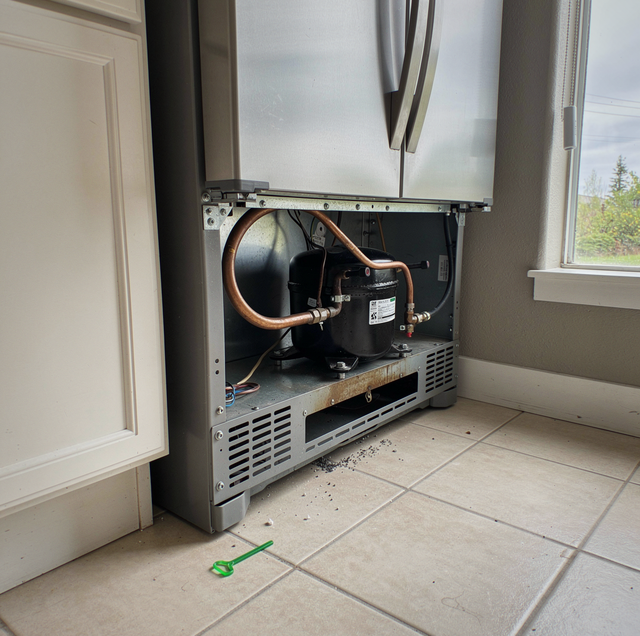
Check power and the temperature setting first, then listen at the bottom of the cabinet for the condenser fan and look for frost on the freezer's back panel. Those checks take a few minutes and sort an overnight failure into three groups: something you can reset, a failed part a repair visit can replace, or a sealed-system fault that needs a different kind of technician.
The order matters because the simple explanations share a symptom with the serious ones: a tripped outlet and a dead compressor both leave warm milk in the morning. What separates them is what is running, what is silent, and where the frost sits, and you can read all three without a tool.
Keep the Door Shut Between Checks
Every opening pulls warm, moist room air into the cabinet. It warms the food, and its moisture freezes onto the evaporator coil inside the freezer. Decide what you want to look at before you open the door, look, and close it.
If food has to move, move it once, into a cooler packed with ice or a second refrigerator that is working.
Confirm Power Reaches the Refrigerator
Open the fresh-food door once. If the interior light comes on and the display is lit, the cabinet has power at the plug, even if the compressor circuit is still dead due to a failed control. If the light and display are both dark, work backward from the refrigerator: the plug fully seated, then the outlet itself (test it with a lamp or a phone charger), then the breaker panel.
A refrigerator plugged in a garage, basement, or outbuilding may sit on a ground-fault outlet, or downstream of one elsewhere on the same wall. One trip cuts it off while the kitchen lights stay on. Look for an outlet with test and reset buttons nearby, press reset, and listen for the compressor.
Check the Setting and the Door
A dial nudged by a gallon jug takes seconds to put right. On numbered dials, the higher number is colder on some models and warmer on others, so read the label printed beside the control before turning it.
Where the refrigerator lives changes how you read this check. Inside a heated house, the air around the cabinet stays warm enough that the fresh-food sensor keeps asking for cold, and a warm cabinet points back at the setting, the door, or a part. Out in a garage or outbuilding with no heat, the surrounding cold makes the job harder. On refrigerators that sense temperature in the fresh-food section only, chilly air around the cabinet can keep that section cool enough that the compressor barely runs, and the freezer side drifts warm. A unit that ran fine all summer and lost its freezer on the first cold night may have nothing broken at all.
Then the door. A door that failed to latch overnight leaves frost on the items nearest the opening and water beading on the liner. Check what held it open: a crisper drawer off its track, a bin pushed out, a tall bottle in the door rack. Close the door on a sheet of paper at several points around the gasket, then pull it out; a gasket that is sealing gives a firm drag, and paper that slides out freely indicates a gap.
A cabinet whose front sits lower than its back lets the doors drift open; raising the front leveling legs a turn or two lets them swing shut.
Listen at the Bottom for the Condenser Fan
The compressor pushes hot, high-pressure refrigerant gas through the condenser coil, where it sheds heat before returning to the freezer. On frost-free refrigerators with the condenser underneath, a small fan beside the compressor pulls room air across that coil, and it runs whenever the compressor runs. Some older models use a static coil on the back with no fan.
Kneel at the front grille or pull the refrigerator out far enough to hear the lower back panel. Three outcomes matter:
Compressor humming, fan spinning: The refrigeration side is running. The fault sits in how cold is made at the coil or moved into the fresh-food section, so the frost check comes next.
Compressor humming, fan silent: The condenser fan motor has stopped, or debris is jamming the blade. Without airflow, the compressor overheats, and its overload switch shuts it off, causing the cabinet to warm in cycles. A fan motor is a replaceable part.
Both silent with the light on and the setting correct: the control may not be calling for cold, the control board or its relay may have failed, or the compressor's start components may be failing. A click from the compressor area every few minutes, with no hum following it, is the start relay or overload trying to start the compressor and giving up. The relay is a part; whether the compressor behind it has also failed is a question for a meter.
Look for Frost on the Freezer's Back Panel
The evaporator coil sits behind a panel at the back of the freezer, or under its floor on some bottom-freezer models. A fan behind the same panel blows air across the coil and through a duct into the fresh-food section, where a damper meters the amount that arrives. At set intervals, a defrost heater warms the coil to melt off the frost it collects, governed by a defrost thermostat or sensor and a timer or control board.
Thick white frost on the panel or around the vents: The defrost system has stopped clearing the coil. Air can no longer pass through the ice, so the fresh-food side warms first and the freezer follows. The candidates are the defrost heater, the defrost thermostat or sensor, and the timer or board that runs the cycle. The decline is gradual, but it is noticed on the morning the last of the airflow closes off.
Freezer cold, fresh-food side warm, no frost on the panel: Cold is still being made and is not being moved. The evaporator fan is the first suspect. On models where the fan stops when the freezer door opens, press and hold the door switch with the door open and listen for the fan behind the panel. Silence points to the fan motor; a fan that runs moves the suspicion to the air damper or to food packed against the vent between the two sections.
Never chip frost off the freezer's back panel with a knife, screwdriver, or ice pick. The evaporator tubing behind it is thin, and one puncture releases the refrigerant. A certified refrigeration technician handles that repair.
Signs That Point to a Part or the Sealed System
The table below summarizes the checks; the right-hand column indicates who does the work.
| What you find | Where it points | Part or sealed system |
|---|---|---|
| Light and display dead, outlet dead | Outlet, breaker or ground-fault trip | Neither: reset it |
| Light on, compressor and fans silent, setting correct | Control board, relay or start components | Part |
| Compressor clicks every few minutes with no hum | Start relay or overload, sometimes the compressor | Part first; a failed compressor goes to referral |
| Compressor humming, condenser fan still | Condenser fan motor or a jammed blade | Part |
| Heavy frost on the freezer back panel | Defrost heater, thermostat, sensor, timer or board | Part |
| Freezer cold, fresh-food side warm, no frost | Evaporator fan, air damper or a blocked vent | Part |
| Compressor and both fans running nonstop, condenser coil barely warm, cabinet barely cool | Refrigerant loss or a compressor that runs without pumping | Sealed system |
| Compressor silent and hot, start components test good | Seized or failed compressor | Sealed system |
A sealed system is the compressor, the condenser and evaporator coils, and the tubing that joins them, all holding refrigerant under pressure. A fan, a heater, a relay, or a board can be replaced on a repair visit. Anything that requires opening the refrigerant circuit is a diagnosis and referral: the repair visit identifies the fault, and the work goes to a certified refrigeration technician. On an older refrigerator, that diagnosis is also the point at which to weigh repair against replacement, because a sealed-system repair can approach the appliance's value.
A refrigerator that stops overnight may have been giving warning for a while: a fan that changed its pitch, a compressor that ran longer each day, a panel that frosted a little more each week. Write down what you heard and saw this morning before you forget it. Those few details are what turn a service call from a hunt into a confirmation.
Frequently Asked Questions
Give it a full 24 hours to settle at its set temperature before judging the result, especially with a full load of warm food inside. The freezer air should feel noticeably colder within the first hour or two; if it does not, the fault persists.
Probably not. A restart can clear a control board that locked up or give an overheated compressor time to cool and reset, but both faults can return. Note the date and time it failed and how long the restart held, because that pattern helps separate a board fault from a starting problem.
Some electronic models have a showroom or demo mode that runs the lights and display with the cooling switched off, and a stray button combination can turn it on. The exit sequence is in your owner's manual or on the label inside the door; the cooling returns as soon as the mode is off.
No. On a refrigerator with a single-speed compressor, the compressor runs at the same speed regardless of the setting; a colder setting only shifts the point at which it stops. Once the fault is fixed, the coldest setting can freeze produce in the fresh-food section, so keep the dial at its normal setting and the readings after the repair will mean something.
No. On some refrigerators, a loop of condenser tubing or a small heater runs behind the cabinet sides or the door frame to keep condensation from forming around the gasket, so warm sides are normal while the compressor runs. On models with the tubing loop, sides that stay cool on a unit that should be running are the clue, because that tubing only warms when the compressor is pumping.
Not on its own after an overnight stop. Dust-packed coils cause a gradual loss of cooling over weeks, with the compressor running longer and longer. They are worth cleaning anyway: unplug the refrigerator first, remove the front grille, and work a long, narrow coil brush through the coil, then vacuum what comes loose.
Keep the door shut and arrange a refrigerator diagnosis — the fan, defrost and control checks done in one visit, with a sealed-system fault named and referred if that is what it turns out to be. SD Appliance serves Spokane, Spokane Valley and North Idaho. Call (509) 866-6767.
