
Dishwasher Leaking Under the Cabinet: Is It Safe to Keep Running?
A dishwasher holds water two ways while it runs: pooled in the sump at the bottom of the tub between cycles, and moving at pressure through the spray arms, the circulation pump, the drain pump, the inlet valve, and a web of hoses and fittings underneath the unit. Every one of those parts seals against water it is built to hold, and every seal is a place that can eventually fail. A leak under the cabinet almost never means the whole machine is about to quit. It means something that should hold water- a seal, a hose, a valve, or the door itself- has started letting it go somewhere it should not, and the water has been finding the cabinet floor instead of the drain.
Reading Where and When the Water Appears
Door gasket: The rubber or foam strip that seals the tub opening against the door is the leak source that shows itself fastest, because it weeps during the parts of the cycle when water is sprayed against the door, not just sitting in the sump. A gasket that has hardened with age or pulled loose at one corner lets a thin line of water run down the face of the door and onto the floor in front of the unit, worse during the main wash and rinse than during the dry cycle. It is also the easiest fault to rule in or out: if the water appears at the front, along the lower door seam, the gasket is the first place to look. If it shows up farther back, under the unit itself, the source is somewhere else entirely.
Hose and fitting leaks sit behind the lower access panel and are harder to spot without pulling the unit forward. Supply-line and drain-hose connections are held with worm-gear clamps or quick-connect fittings, and either one can loosen over years of vibration, or the hose itself can crack where it bends. The timing is the clue here: a leak that only happens while the unit is filling points at the supply connection, while one that shows up only as the pump cycles water out points at the drain hose or its clamp.
The table below separates the common sources by where and when the water appears.
| Where the water appears | When it happens | Likely source |
|---|---|---|
| Along the lower door edge | During wash or rinse | Door gasket |
| Pooled directly under the unit, mid-cycle | During fill | Supply line or inlet valve |
| Pooled directly under the unit, mid-cycle | During drain-out | Drain hose or clamp |
| Slow, constant, even when the unit is off | Any time | Supply line, inlet valve, or a sump or pump seal |
| At the sink cabinet, not the dishwasher's toe-kick | Any time | Plumbing, not the dishwasher |
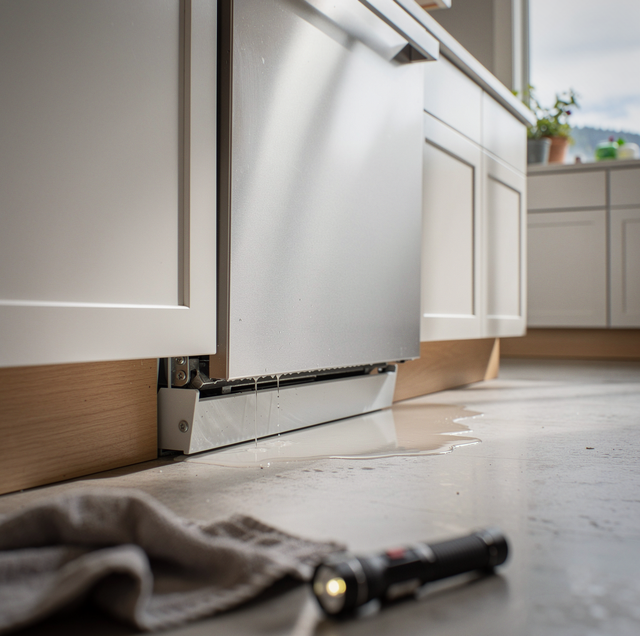
Slide a flashlight and a dry towel under the unit before the visit: the towel soaks up what has pooled, and the beam shows whether water is coming from the door, the hoses, or farther back at the sump.
The Sump and Pump Seals Leak More Slowly
The sump sits at the lowest point of the tub, where the circulation pump pulls water up to the spray arms, and the drain pump pushes it back out through the drain hose. Both pumps pass a motor shaft through a seal into the wet side of the tub, and that seal is rubber wearing against a spinning shaft for years of cycles. When it starts to go, the result is not a sudden flood but a slow, steady weep that can run for weeks before anyone notices, because it happens low, at the back of the unit, under the toe-kick where nobody looks. A cabinet floor that feels soft or has started to swell near the dishwasher, with no obvious puddle anywhere, points at a slow source, a sump or pump seal or a weeping supply fitting, before it points at the gasket.
A Water Inlet Valve That Will Not Fully Close
The inlet valve is a solenoid that opens to let supply water into the tub and is supposed to close completely between fills. A valve with a worn diaphragm or a stuck plunger lets water seep into the tub between cycles, and a cracked valve body or a loose fitting where the supply line meets it drips onto the floor. That timing detail matters: water under the unit first thing in the morning, before a single cycle has run, points at the supply side, the line, its fitting or the valve body, because that is the one part that holds house pressure while the unit sits idle. A worn sump seal can also seep slowly while water sits in the sump.
When the Leak Is Plumbing, Not the Dishwasher
A leak at the sink drain, the trap under the sink, or the supply pipework feeding the kitchen is plumbing work, not appliance repair, and the distinction matters for who gets the call. Water from a dishwasher fault shows up at the dishwasher's toe-kick or front panel. Water pooling at the sink cabinet, around the trap, or along a supply line that has nothing to do with the dishwasher's own connections is a separate system with a separate fix. A leak that starts within days of a new installation points first at the hookup rather than a failed part: a supply fitting at the inlet valve that was not tightened or sealed, or a drain-hose clamp left loose. That goes back to whoever installed it, or to a plumber where the fault is in the sink's own pipework.
What to Do Before the Technician Arrives
A slow leak is still worth stopping the moment it is found, even though nothing about it looks urgent. Particleboard and plywood cabinet floors absorb standing water and begin to swell and soften within a day or two, well before any staining or sagging is visible from on top, which is why a leak that gets ignored for a week does real damage even though it never looked like much. Stop running the dishwasher, shut the water supply valve under the sink, and soak up any standing water with towels so the cabinet floor has a chance to dry rather than sitting wet until the visit.
If water has reached a junction box or cord connection under the sink, don't reach in. Shut off the breaker feeding the dishwasher, not just the switch, and leave any rewiring to an electrician once the area is dry.
A leak that keeps a dishwasher from running for a few days costs nothing beyond the inconvenience. A cabinet floor that sits wet for that same stretch can end up costing more to repair than the dishwasher itself. Tracing the leak from underneath, with the unit pulled forward and the source confirmed before anything is tightened or replaced, is what keeps a simple gasket or hose fix from turning into a guess.
Frequently Asked Questions
Yes. A squirt of hand dish soap foams far beyond what the tub and door gasket are built to contain, and the suds push out at the bottom of the door. Wipe out what you can, run a rinse-only cycle, and the leak stops once the foam is gone.
Not until the source is known. Particleboard that has swollen stays swollen after it dries: the edges do not shrink back, and the panel does not regain its strength, so every extra load adds damage that drying will not undo.
Dampness that appears only during drying can be steam, not a leak. On models that vent through the top of the door, the steam can condense on the underside of the countertop and run down the cabinet face. It stops when the cycle ends, and it shows along the front edge, not under the unit.
Yes. A unit that tips forward, because a leveling leg has backed off or the mounting brackets under the countertop have come loose, pushes water against the lower door seal on every fill. With the door open, a level laid across the front edge of the tub should read level or tip slightly toward the back.
Particleboard wicks water sideways through the material faster than it shows on the surface, so a damp spot a foot or more from the dishwasher can be the only visible sign of a leak happening directly under the unit, with the water traveling through the wood before it ever pools where it is easy to see.
It can. Some sinks have a single dual-outlet stop valve that supplies both the faucet's hot line and the dishwasher, so closing it leaves the faucet without hot water until the repair is completed. When the dishwasher has its own valve, the sink continues to work normally.
Get the leak traced before it reaches the subfloor — a dishwasher leak followed from underneath to the seal, hose, pump or valve that let go. SD Appliance serves Spokane, Spokane Valley and North Idaho. Call (509) 866-6767.
